Wednesday, February 24, 2021

St. Photios Greek Orthodox National Shrine, St. Augustine, FL.


February 18, 2021


The St. Photios Greek Orthodox National Shrine is located on the property of the Avero family, who lived there from 1712 to 1804.  The Shrine--a magnificently painted chapel located at the back of the property--commemorates the first Greek settlers in America.  These settlers originally landed in New Smyrna, but after living in slave-like conditions, they revolted against Turnbull.  Their lives in New Smyrna consisted of clearing alligator-infested swamps with little food and the ever-present risk of malaria.  Refusing to endure any longer, they broke into storehouses, captured a supply ship, and prepared to escape.  In response, Turnbull executed three men as examples.  The revolt failed, but three men secretly made the 75 mile journey to St. Augustine to plead with Governor Tonyn.  Tonyn heard their plea, and allowed 600 men, women, and children to flee to St. Augustine in 1777.  Here, they met at the Avero's home to worship.  The museum within the Shrine now celebrates the lives and displays artifacts from these first Greek settlers.  Archbishop Iakovos christened the Shrine in 1971.  He named it after and dedicated it to St. Photios.  Icons and paintings of him are displayed throughout the museum and chapel.  Even the peacocks painted at the entrance symbolize this saint.  The Greek Orthodox remember St. Photios for fighting against iconoclasm, so it is fitting that the museum walls are filled with beautiful icons.  Other Greek Orthodox artifacts are displayed throughout the museum, such as the priests' robes and staffs.

Click here to access the Saint Photios Greek Orthodox National Shrine website where I obtained this information and where you can read further about this fascinating site.


Artifact 1: St. Photios Shrine Cross


This small wooden cross was discovered in an archeological dig of the site.  A main doctrine of the Greek Orthodox is the Trinity, so the three wholes in the cross represent the Father, Son, and Holy Spirit.  Archbishop Iakovos designated the cross as the St. Photios Shrine Cross.  It is still considered a symbol of the Shrine and the Greek settlers' strong faith.  Other copies of the cross were created, such as this replica on display at the museum:


Artifact 2: Vestiments of Archbishop Iakovos


These vestments were given to the St. Photios Shrine by Archbishop Iakovos in 1982.  Every piece and intricately embroidered detail represents some scripture or Orthodox doctrine.  Most of the passages depicted on the vestments come from the Old Testament, particularly Psalms.  Every time the Archbishop put on these robes, he would be reminded of scripture and his sacred calling.  

Photos of the Exterior and the Interior Chapel


Photographs in Conversation with this Site:


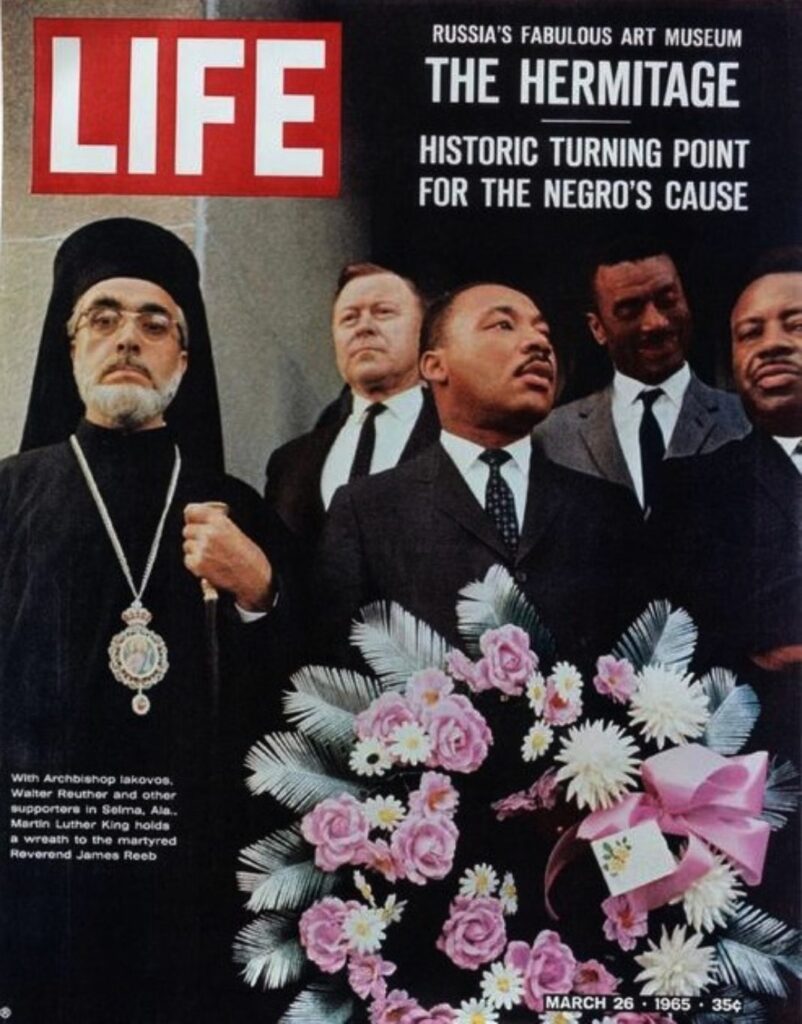
The vestments I observed at the shrine are special in particular, because Archbishop Iakovos courageously marched alongside Martin Luther King, Jr. in Selma, Alabama.  Pictured above is  the famous cover of LIFE magazine, where Iakovos stands with MLK.


This photo was taken in 1975 at the dedication of a memorial for Father Pedro Camps.  The memorial still stands outside the Cathedral Basilica today, and honors the memory of "The spiritual leader of the Minorcan Colony."  It was revealed on the 200th anniversary of the Minorcan Colonists arrival in St. Augustine.

(image source link: https://www.floridamemory.com/items/show/40880 )


Creative Component:


When we visited St. Photios, I was struck by a wooden cross displayed at the entrance.  It was discovered during an archeological dig of the site, and little is known about its origin.  This mystery surrounding the symbol of the Shrine and the Minorcans' faith pricked my imagination.  I imagined all the weary travelers who might have clung to this cross on the treacherous trek to freedom.  I thought of the women and children who may have carried this cross through the dangerous swamps.  As I searched for the stories of these inspirational and courageous women, I met dead ends at every turn.  Though there are many stories left untold, they matter.  This watercolor and Prismacolor pencil illustration is a solemn tribute to the Minorcan women who survived the horrors of Turnbull's plantation, carried their families to safety, and made a new life for themselves in St. Augustine through their faith and courage.  


ENG 202 Connection:


"It was dark inside, the westward window admitting but a feeble light from the darkening sky.  The cross bar of the window showed black against the opening.  His mind called up a sudden image of Modeste telling his story of how the Salish people set out to find the 'new thing'--one stick laid across another; a great power was to come to them when they had that.  Here it was, staring meaninglessly at him."

-D'Arcy McNickle, The Surrounded (p. 257)

Here, the protagonist (Archilde) glimpses the darkening sky through his window as he goes to see his dying mother.  Immediately, the panes made him think of a cross.  For his people, the cross was a kind of magic charm: the physical item itself was believed to hold powers.  But they were sorely disappointed when they found it was actually a symbol of something intangible.  On their journey to freedom, the Minorcans also held onto the cross, but they did recognize that it was a symbol of something greater than "one stick laid across another."  For them, it was a beacon of hope and light in their darkest hour.  It was a solid reminder of the faith that carried them through trial after trial--not a literal manifestation of faith itself.


Thursday, February 18, 2021

The Oldest House Complex


February 11, 2021


Also known as the Gonzalez-Alvarez House, the Oldest House Complex vividly monumentalizes St. Augustine colonial history.  The oldest house in Florida, the complex tells the stories of the Spanish and then British families who lived there.  The complex itself dates back even further than the building, to the 1600s.  The current house was completed in 1790.  The stark contrast between the first floor and the second reflect the contrasting lives of the families that dwelt there.  Originally, when Tomas Gonzalez y Hernandez lived there, the house was just the rectangular first floor.  Now the windows have glass panes, but originally they were open with wooden shutters.  The fire-pit at the center of the room would have provided smoke to repel mosquitoes which plagued early settlers.  The rooms are built of coquina and plastered with lime and whitewash.  The second family to live at the Oldest House was the family of a British soldier, Sergeant-Major Peavett.  Peavett added the second story.  The last family to dwell in this home was the Alvarez family.  Geronimo Alvarez renovated the home to its current state.  The St. Augustine Historical Society acquired the complex in 1918.  Since, they have studied, maintained and preserved the site.  The St. Augustine Historical Society's mission is "to acquire, preserve, and interpret the historical resources of St. Augustine and its sphere of influence for the benefit of the public through its stewardship of historic buildings and collections, research, publications and eduction programming."

Click here to access the National Park Service website where I obtained this information and where you can read further about this site.


Artifact 1: Wooden Paneling on the Second Floor Walls


In one of the rooms on the far side of the upper story, the walls are paneled with this deep brown wood.  At first glance, it seems like a design choice.  However, this wood was salvaged from an old church that was torn down.  Peavett saved the wood and made it part of his home.  Knowing this changes the atmosphere of the room, giving it a solemn and heavy presence.  It is also a tangible reminder of the mix-matched history of this site.  The pieces of three families' lives are patched together in this space, much like the hundreds of stories that are stitched into the history of St. Augustine itself.  Tragically, some stories are left untold--even brushed aside--while others are given a prominent place to shine.  However, the Historical Society is working to uncover more stories to share with our community.

Artifact 2: Bed of General Hernandes


The furnishings that fill the Oldest House are not original to this location.  This piece from 1825 was once the bed of General Hernandez, who is remembered for capturing Osceola.  This bed--and the other pieces that fill the rooms--illustrate the collaborative nature of preserving and sharing history.  The Historical Society works with communities and museums around the country to create spaces like this bedroom.  Research and academic work is not an isolated process--it takes teamwork.


Photos of the Exterior and Complex Grounds:


This is a water jar that the Gonzalez family would have used to collect rain water.  The arches in the background are a beautiful coquina passageway connecting two of the complex buildings.


Photos in Conversation with the Site:


During our discussion at the Oldest House Complex, Professor Vigliotti talked about the St. Augustine Historical Society's research on the location of slave quarters on the Oldest House property.  Because there are little to no records about where these quarters would have been located or about the slaves living in them, this information was very difficult to uncover.  Like the Oldest House Complex, Fish Island on Anastasia Island--in St. Augustine--has much to uncover about the lives of African slaves in Florida.  Fish Island was once the location of the first commercial orange grove in Florida, owned by Jesse Fish.  Fish had over 100 slaves on his extensive plantation between the years 1752 and 1763 (the First Spanish Period).  These slave burials are important, because they tells about Protestant slaves who could not be buried in the Catholic Tolomoto Cemetery.  Recently, Fish Island was making local headlines as community members joined together to protect it from becoming a housing development.  Thanks to their efforts, the State of Florida purchased the land, and it is now a preserve.  For more information about Fish Island's history click here.  If you would like to read more about the Fish Island case click here.  Here is a photo of the island today:


(image source link: https://cleanupcityofstaugustine.blogspot.com/2018/07/riverkeeper-fish-island-would-change.html )

Creative Component

This is a Prismacolor pencil drawing of indigo-stained hands.  Beneath are indigo leaves to reinforce this idea.  As we discussed the Minorcans' struggles at the New Smyrna plantation, I was struck by the image of the indentured servants' blue-stained skin.  They were marked by the indigo trade both mentally and physically--the blue stains being a physical indication of their inward marks.  We often associate blue skin with death or a lack of oxygen.  So, to me, blue-dyed skin has a cold, dead connotation.  While the Minorcans' hopes for a better life in the New World were crushed by Turnbull's cruel dishonesty, the hopeful glow and vigor of their skin was replaced by deathly blue pallor.

--Upon further research, I found that the indigo vats were not likely located at Turnbull's plantation.  I also discovered that it was black slaves--not indentured servants such as the Minorcans--who would have processed and been dyed by the indigo.  However, I wanted to keep this creative response in my archive, because it still represents my thinking and response to this site visit.


ENG 202 Connection:


"I lost an arm on my last trip home.  My left arm.  And I lost about a year of my life and much of the comfort and security I had not valued until it was gone."

-Octavia Butler, Kindred (p. 9)

Though this scene appears at the opening of Butler's novel, it is the final scene.  Dana has been through so much, seen so much, and lost so much at Weylin's slave plantation.  Her amputated arm is a kind of stigmata: a physical marking that represents much deeper wounds--be they spiritual or mental.  The Minorcans were also marked--marked by the whip and stained blue by indigo.  Like Dana, they lost the life they once had forever.  They sailed across the sea with bright hopes and dreams for the New World, only to be treated as slaves.  They escaped their captors, but they did not escape whole--so many loved ones died and so many horrors stained their memories.


Tuesday, February 9, 2021

Miscellaneous Historical Civil Rights Sites in St. Augustine, Florida


February 4, 2020


Artifact 1: Frederick Douglass Marker


At this spot on St. George Street, once stood the Genovar Opera House.  Here, Frederick Douglass spoke about the civil rights struggles facing black men and women after the Emancipation Proclamation.  When he arrived here, he was warmly welcomed by the Mayor of St. Augustine and the Governor of Florida.  An escaped slave himself, Douglass was a catalyst for change in America and encouraged his friend, Abraham Lincoln, to issue the Emancipation Proclamation.  Sadly, the opera house was burned to the ground in the great fire of 1914.

Exterior Photo: View of St. George Street


Artifact 2: The Monson Motor Lodge


This Hilton Hotel was built where the Monson Motor Lodge once stood.  Where a new pool glistens in the Florida sunlight, a different pool saw a famous incident in St. Augustine civil rights history.  In that pool, on June 18, 1964, several brave protestors demonstrated against segregation.  They refused to leave the "whites-only" swimming pool, causing one white man to jump in and attempt to clear them out.  The motel manager--James Brock--tried to take control of the situation by pouring chemicals into the pool.  All of the protestors were arrested, but their arrests were not in vain.  Their courage pushed America toward the passage of the Civil Rights Act of 1964.


This drab marker memorializes the Monson Motor Lodge event.  It reads:
"The Monson Motel formerly located on this site was the focal point of demonstrations led by Dr. Robert B. Hayling and Dr. Martin Luther King Jr. that resulted in the passage of the Landmark Civil Rights Act of 1964."

Hilton Hotel Exterior


Photos in Conversation with these sites:


This is an old photograph of the Great Fire of 1914.


Another photo of the Monson Motor Lodge incident.  A man jumps in to clear protestors from the pool.  Unlike the pool that stands there today, we can see the original pool was easily accessible to the public.  The new pool has a concrete wall separating it from the street, whereas the old one had a small chain rail.


Creative Component


I took this photograph of a splash in the fountain behind St. Augustine's Governor's House.  I was captivated by the famous phrase which made headlines the day of the Monson Motor Lodge Demonstration: "The Splash Heard 'Round the World."  I feel this phrase captures how momentous this event--and others like it in St. Augustine--was to the passage of the Civil Rights Act of 1968.  Including this phrase on the Monson Motor Lodge Pool marker would have had a greater impact on the reader than the passive language of the current signage.


ENG 202 Connection:


"...why couldn't I just turn these two kids away, turn off my conscience, and be a coward, safe and comfortable?"

-Octavia Butler, Kindred (p. 106)

In this passage, Dana struggles between choosing between passivity and action.  Two slave children on the plantation ask her to teach them to read.  She knows that teaching them could be dangerous and possibly fatal for her; it would anger both the slaves and the slave masters if they found out.  But she cannot "turn off [her] conscience."  Protestors at the Monson Motor Lodge also had to choose whether to stay silent or act.  The black demonstrators chose to take physical action so that their voices would be heard.  The white observers and fellow demonstrators had to choose how they would respond to the situation.  Some would stay safe and silent, watching the protest from the poolside.  Some would act in aggression and opposition--the motel owner would pour chemicals into the pool with the protestors.  Still others would choose to have courage, to listen to their consciences, and jump right in the pool with them.  


Wednesday, February 3, 2021

Lincolnville Museum and Cultural Center, St. Augustine, Florida


January 28, 2021


The Lincolnville Museum and Cultural Center opened its doors to the public in 2012.  The building was originally Excelsior High School for black teenagers--in fact, it was the first black high school in the county when it opened in 1925.  When segregation ended, the school closed.  In 2012, the building was nearly demolished to make way for a new park, until former students and the St. Augustine community stepped in to save it.  The Museum's mission is "to preserve, promote and perpetuate over 450 years of the African American story through the arts, educational programs, lectures, live performances and exhibits."  This site contains rich civil rights history as well.  One of its teachers, Edward D. Davis, worked with several other renowned civil rights leaders to provide equal pay for both black and white teachers in America.  Men and women who graduated from this high school also made great contributions to civil rights.  Some such people were Henry Thomas--one of the original Freedom riders--and Henry and Katherine Twine.

Here is a link to the Lincolnville Museum and Cultural Center website where I obtained this information and where you can read further about this site: https://www.lincolnvillemuseum.org/about


Artifact 1: Martin Luther King Jr.'s Fingerprint Card


This fingerprint card was made when Martin Luther King Jr. was jailed in St. Augustine.  The Museum is honored to have this piece, as it is the only surviving record of any of King's arrests--possibly the only record ever taken of his arrests.  King was arrested on June 11, 1964 when he protested in downtown St. Augustine.  The Sheriff's department ran out of St. Augustine fingerprint cards because so many arrests were made that night.  So, King's was made on a Putnam County card.  King was buried in Atlanta--his hometown--but Lincolnville has this artifact to hold onto him.


Artifact 2: Artifacts from the Kelton Family Site


King's fingerprint card contrasts starkly with this glass case of artifacts within the Museum.  While Lincolnville's history was carefully preserved by some, others bulldozed over it.  At times, literally, like in the case of the Kelton Family Home.  Four generations of Kelton's lived in this Victorian home, until it was demolished to build a brand new house.  In 2002, city archaeologists were able to dig through this site and find the broken pieces of this family's life.  As they put the pieces back together, it formed a greater picture of life in Lincolnville for an early 20th century black family.  The archaeologists learned what these families ate, how they dressed, the games their children played, how they decorated their homes, and the kinds of personal items they used. 


Exterior Photographs:


Creative Component:


I created this short clip of bricks on the streets of St. Augustine by cross-fading two photographs I took.  These bricks have always caught my attention, because they are printed with my hometown and my mother's maiden name.  I have always loved the idea of Birmingham clay mixing with St. Augustine sand, because it reflects my own history.  After visiting the Lincolnville Museum, these bricks took on a new meaning.  Birmingham is remembered by its Civil Rights history, but many forget how important St. Augustine was to the Civil Rights movement.  These bricks--bricks which Martin Luther King tread on--are an enduring reminder of what happened here.  Sadly, many of the prints on these streets are fading.  Cars and horses' hooves smooth the bricks and fade the markings.  But though these physical markers fade, people like those at the Lincolnville Museum carry on the memory and history of the St. Augustine Civil Rights movement.  

Photographs in conversation with this site:


This photograph was taken by Richard Twine in 1922.  It is displayed in the Lincolnville Museum and captures the Lincolnville Emancipation Day Parade.  Twine was a black photographer and gives us a unique perspective of Lincolnville in its heyday.  In this image, we see a bustling, well-maintained part of the city that is filled with people and activity.


This is a self-portrait of Richard Twine, taken in 1922.  He was born and raised in Lincolnville, St. Augustine after seven older siblings.  Opening his own studio, he became one of only two photographers in Lincolnville.  Capturing the life and people of Lincolnville, he photographed candid moments at local events, weddings, and funerals.  In his studio collection are stunning portraits of men, women, and children in their Sunday best.


ENG 202 Connection:


"'Look, I won't say I understand how you feel about this because maybe that's something I can't understand.  But as you said, you know what's going to happen.  It already has happened.  We're in the middle of history.  We surely can't change it...'
'Maybe.'  I drew a deep breath and let it out slowly.  'But I can't close my eyes.'"

-Octavia Butler, Kindred (p. 100)

In this passage, the protagonist (Dana) and her husband have been transported back to an 1819 plantation.  Here, they are deciding how they will act.  Will they try to change history, or let it run its course?  Though she knows what has happened and what will happen, Dana cannot close her eyes to the history she is living through.  Our visit to the Lincolnville Museum also took us on a journey through history.  Though we cannot change the past, it brought us face-to-face with it.  We were given the choice to truly see and let it affect us, or to passively observe and move on.

Castillo de San Marcos, St. Augustine, FL

  March 11, 2021 The Castillo de San Marcos is a 320 year old stone fort.  The stone is made of coquina: a local rock composed of shell.  Co...