
February 18, 2021
The St. Photios Greek Orthodox National Shrine is located on the property of the Avero family, who lived there from 1712 to 1804. The Shrine--a magnificently painted chapel located at the back of the property--commemorates the first Greek settlers in America. These settlers originally landed in New Smyrna, but after living in slave-like conditions, they revolted against Turnbull. Their lives in New Smyrna consisted of clearing alligator-infested swamps with little food and the ever-present risk of malaria. Refusing to endure any longer, they broke into storehouses, captured a supply ship, and prepared to escape. In response, Turnbull executed three men as examples. The revolt failed, but three men secretly made the 75 mile journey to St. Augustine to plead with Governor Tonyn. Tonyn heard their plea, and allowed 600 men, women, and children to flee to St. Augustine in 1777. Here, they met at the Avero's home to worship. The museum within the Shrine now celebrates the lives and displays artifacts from these first Greek settlers. Archbishop Iakovos christened the Shrine in 1971. He named it after and dedicated it to St. Photios. Icons and paintings of him are displayed throughout the museum and chapel. Even the peacocks painted at the entrance symbolize this saint. The Greek Orthodox remember St. Photios for fighting against iconoclasm, so it is fitting that the museum walls are filled with beautiful icons. Other Greek Orthodox artifacts are displayed throughout the museum, such as the priests' robes and staffs.
Click here to access the Saint Photios Greek Orthodox National Shrine website where I obtained this information and where you can read further about this fascinating site.
Artifact 1: St. Photios Shrine Cross

This small wooden cross was discovered in an archeological dig of the site. A main doctrine of the Greek Orthodox is the Trinity, so the three wholes in the cross represent the Father, Son, and Holy Spirit. Archbishop Iakovos designated the cross as the St. Photios Shrine Cross. It is still considered a symbol of the Shrine and the Greek settlers' strong faith. Other copies of the cross were created, such as this replica on display at the museum:

Artifact 2: Vestiments of Archbishop Iakovos

These vestments were given to the St. Photios Shrine by Archbishop Iakovos in 1982. Every piece and intricately embroidered detail represents some scripture or Orthodox doctrine. Most of the passages depicted on the vestments come from the Old Testament, particularly Psalms. Every time the Archbishop put on these robes, he would be reminded of scripture and his sacred calling.
Photos of the Exterior and the Interior Chapel


Photographs in Conversation with this Site:

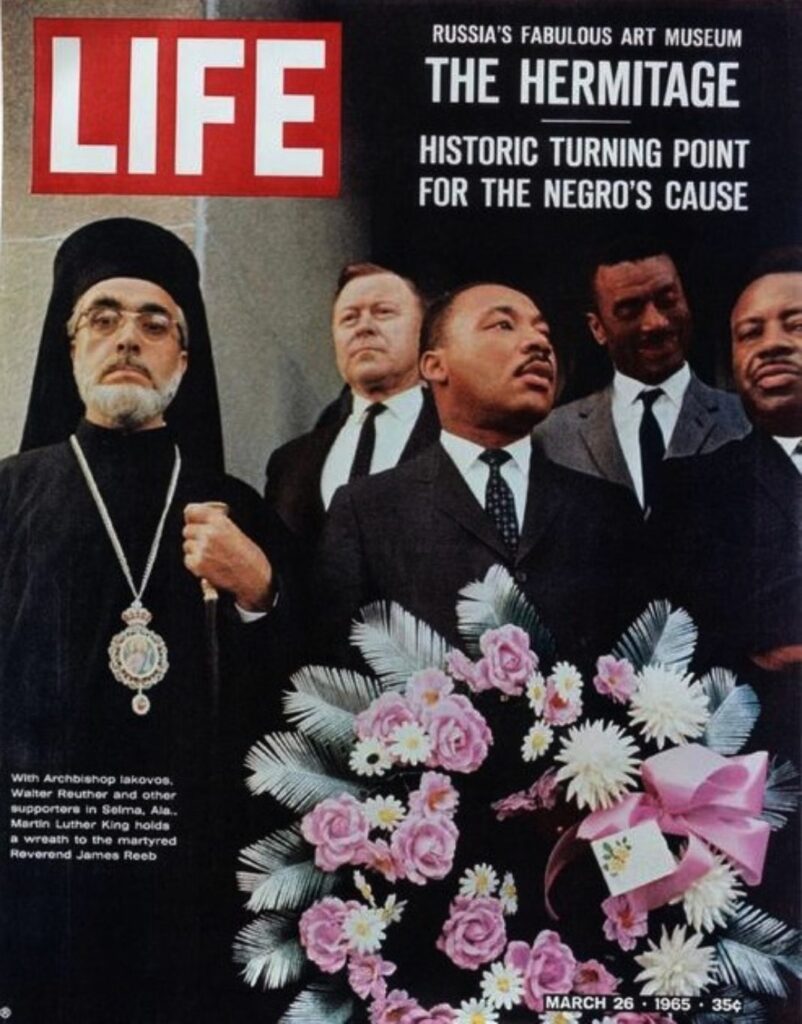
The vestments I observed at the shrine are special in particular, because Archbishop Iakovos courageously marched alongside Martin Luther King, Jr. in Selma, Alabama. Pictured above is the famous cover of LIFE magazine, where Iakovos stands with MLK.
(image source link: https://greekcitytimes.com/wp-content/uploads/2021/01/iakovos_martin_luther_king_jr-1068x1364-1-802x1024.jpg )

This photo was taken in 1975 at the dedication of a memorial for Father Pedro Camps. The memorial still stands outside the Cathedral Basilica today, and honors the memory of "The spiritual leader of the Minorcan Colony." It was revealed on the 200th anniversary of the Minorcan Colonists arrival in St. Augustine.
(image source link: https://www.floridamemory.com/items/show/40880 )
Creative Component:

When we visited St. Photios, I was struck by a wooden cross displayed at the entrance. It was discovered during an archeological dig of the site, and little is known about its origin. This mystery surrounding the symbol of the Shrine and the Minorcans' faith pricked my imagination. I imagined all the weary travelers who might have clung to this cross on the treacherous trek to freedom. I thought of the women and children who may have carried this cross through the dangerous swamps. As I searched for the stories of these inspirational and courageous women, I met dead ends at every turn. Though there are many stories left untold, they matter. This watercolor and Prismacolor pencil illustration is a solemn tribute to the Minorcan women who survived the horrors of Turnbull's plantation, carried their families to safety, and made a new life for themselves in St. Augustine through their faith and courage.
ENG 202 Connection:
"It was dark inside, the westward window admitting but a feeble light from the darkening sky. The cross bar of the window showed black against the opening. His mind called up a sudden image of Modeste telling his story of how the Salish people set out to find the 'new thing'--one stick laid across another; a great power was to come to them when they had that. Here it was, staring meaninglessly at him."
-D'Arcy McNickle, The Surrounded (p. 257)
Here, the protagonist (Archilde) glimpses the darkening sky through his window as he goes to see his dying mother. Immediately, the panes made him think of a cross. For his people, the cross was a kind of magic charm: the physical item itself was believed to hold powers. But they were sorely disappointed when they found it was actually a symbol of something intangible. On their journey to freedom, the Minorcans also held onto the cross, but they did recognize that it was a symbol of something greater than "one stick laid across another." For them, it was a beacon of hope and light in their darkest hour. It was a solid reminder of the faith that carried them through trial after trial--not a literal manifestation of faith itself.


No comments:
Post a Comment